/ blog
The Jevons effect and AI in day-to-day life

It’s 11:40 p.m. I’ve got fourteen chat tabs open and I no longer know if I’m editing an idea or editing the anxiety of falling behind. I started the night wanting to solve one thing. I end with five new tasks I wouldn’t even have thought to try before.
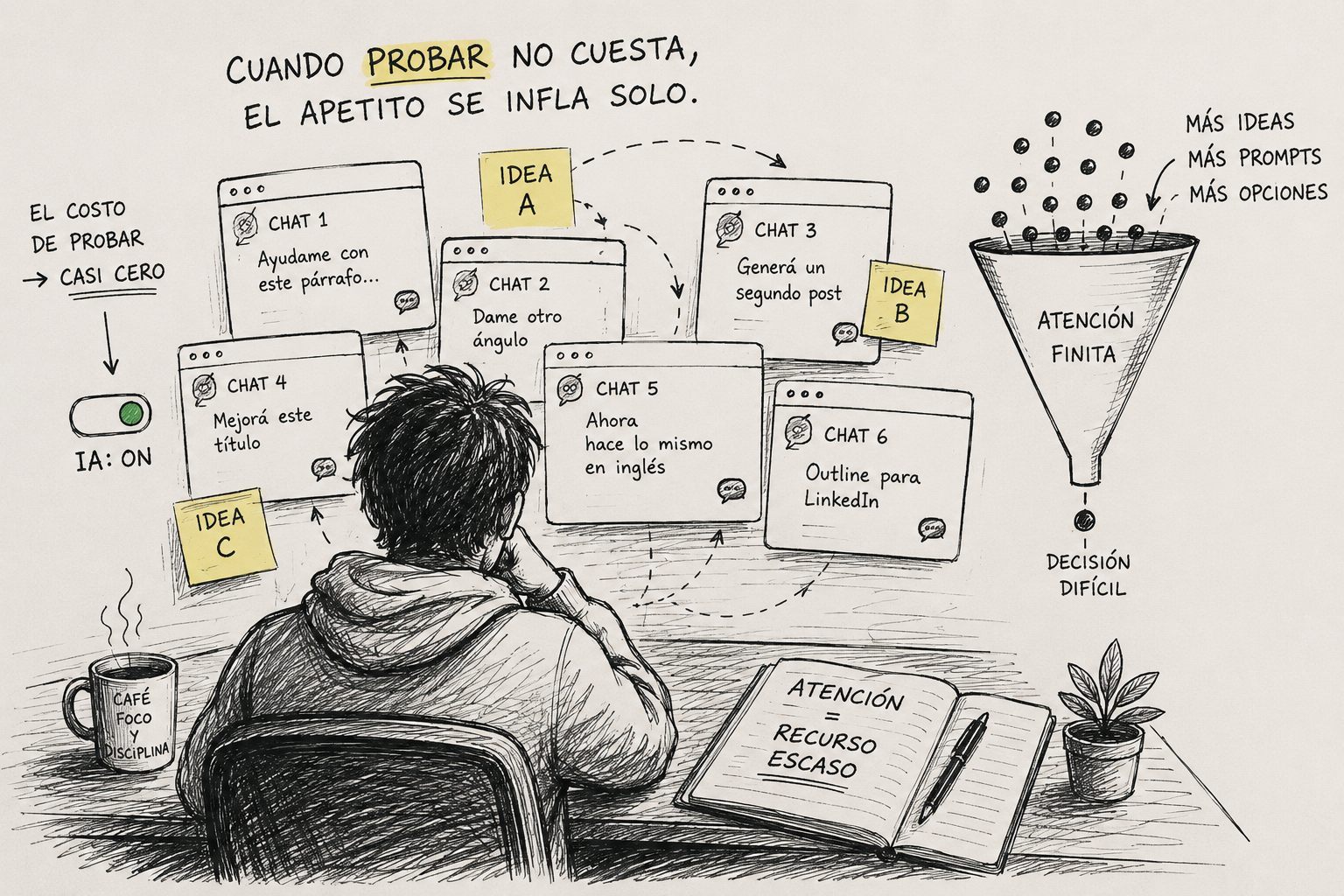
Not because AI replaced me. Because the cost of trying dropped to almost zero, and when trying costs nothing, appetite inflates on its own.
Economics has an elegant name for that: the Jevons paradox. When a technology makes the use of a resource more efficient, instead of consuming less, we end up consuming more. Savings turn into new hunger. At my desk I give it a less elegant name: I opened the chat again.
The public debate is still stuck on “will AI take my job?”. That fear exists, and sometimes it’s real. But it isn’t the one breaking my weeks.
The one that breaks them is smaller and more intimate: the tool doesn’t take the work away from me; it changes the menu. Before, I discarded ideas because they were expensive. Now I try them all. Before, an outline was a decision. Now there are ten outlines in twenty minutes, and the decision hides behind the volume.
The scarce resource was never “generating text”. It was always attention. AI didn’t invent that scarcity. It just put a turbo on it, for free, without me asking.
I see it in three places, almost the same.
At the desk I start asking for help with a paragraph. I end up asking for a second post, a third angle, a “improve this title”, an “now in English”. I’m not working deeper. I’m working wider. And width, past a certain point, is just noise shaped like productivity.
In the homelab I have OpenWebUI, some basic guardrails, an Ollama that sleeps most of the time because the Dell 3040 has honest limits. Self-hosting models was, in part, not wanting to stay out of the wave. It was also touching the real cost with my hands: RAM, CPU, tokens, heat. The same disease as the thirty-meter cable, measured in tokens instead of meters. And even so, with the model inside my network, the effect replicates: more prompts at weird hours, more “I’ll fix it calmly later”. The fix is exactly where the work the tool promised to take off my plate comes back.
At work, if generating costs almost nothing, the expectation to deliver inflates on its own, without anyone negotiating it in a planning meeting. The friendly pressure of “just throw it at AI” shows up. Sometimes it works. Sometimes it hides that nobody looked at the edge of the problem. The seniority I care about measuring — in myself, first — is less and less “who fires more prompts” and more “who knows when not to accept the first output”.
This blog has a founding scar I already told in the homelab post: I got diagnosed with brainrot, Discord soundpad in the background, the day I posted generated text and called it my own thinking. Poetic justice. Deserved punishment.
Since then I treat AI as scaffolding, never as the final voice. It helps with drafts, structure, sorting issues. The prose that goes out with my name I write by hand, slowly, reading aloud like a maniac in the room-office.
That alone isn’t enough. The Jevons effect isn’t fought with good intentions; it’s fought with deliberate friction. Mine is almost childish, and that’s why it works: if the tool speeds up production, I deliberately slow down publication.
In practice, four operating rules. One focus per night: if I opened the chat for post A, I don’t open the outline for post B “because I already have momentum” — that isn’t momentum, it’s Jevons dressed as flow. Draft is not published: I can generate scaffolding in minutes, but between that scaffolding and publish there’s a night of sleep, or at least one full read-aloud, no sympathetic exceptions. A budget of prompts, not of posts: I limit how many times I go back asking for “another version”, because the model’s third rewrite almost never improves the text, it only dilutes my judgment. And publishing less is still a valid metric: if in the week one piece with my own voice went out, I won; if five came out smelling like autocomplete, I lost, even if the “content” dashboard says otherwise.
It isn’t abstinence. It isn’t Luddite pride. It’s a quota. The daily allowance of real focus stays finite with or without a model next to me.
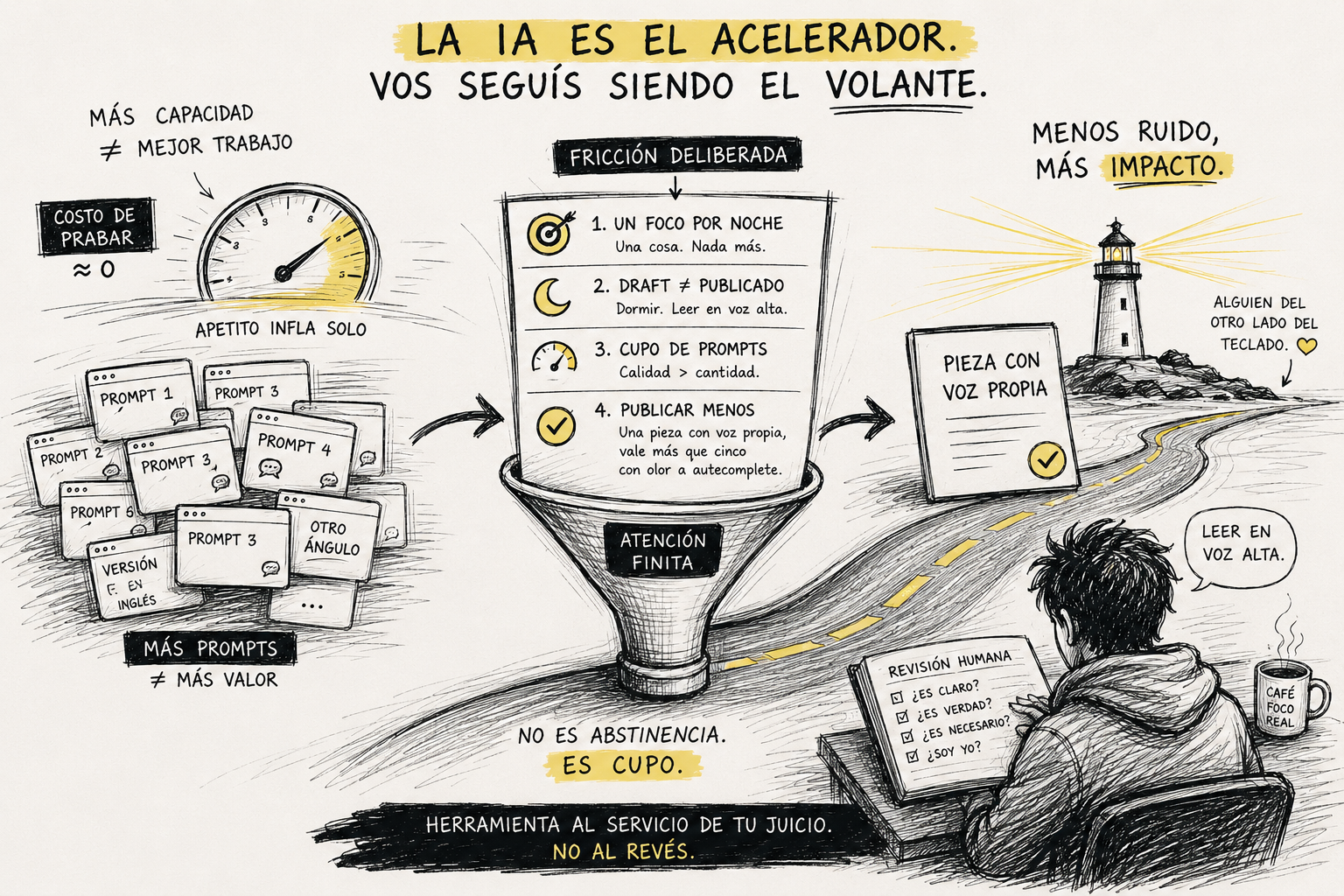
In different gyms I learned the same separation under other names: tone is not message (feedback from real users); speed is not quality (when “the product has priority” becomes a bottleneck); assistance is not authorship (the new muscle of this era). Different problems. Same discipline: don’t confuse the accelerator with the steering wheel.
I can generate ten outlines in twenty minutes. What I can’t do is live ten focuses at once. The Jevons effect, at my desk, looks exactly like that: more apparent capacity, more promises, more guilt when you don’t reach all of them.
The answer I’m practicing isn’t turning AI off. It’s not letting it decide the size of my appetite. Publish less, if needed, but with someone of flesh on the other side of the keyboard. That remains, for me, the only metric you can’t outsource.
If you want the elegant name: Jevons paradox. The brainrot scar is in the homelab project. The logistics of writing, without touching the voice, I’ll leave for the n8n post.