/ blog
When writing for an AI makes you forget the reader

I ran into an article about Generative Engine Optimization, or GEO, explaining how to get ChatGPT to cite your site. Do not block OpenAI’s crawler, keep a healthy sitemap, structure content better, and fill the About page with enough trust signals for an AI to decide it should believe you.
Some of it made sense. The rest made me look at this blog and ask who I was really writing for.
To be fair, the article has several reasonable points. Not blocking bots for sport, having a sitemap, writing with some structure, and making clear who you are and what you actually did. None of that seems wrong to me, and none of it feels particularly new either. Those were good practices long before someone decided to bundle them under a three-letter acronym.
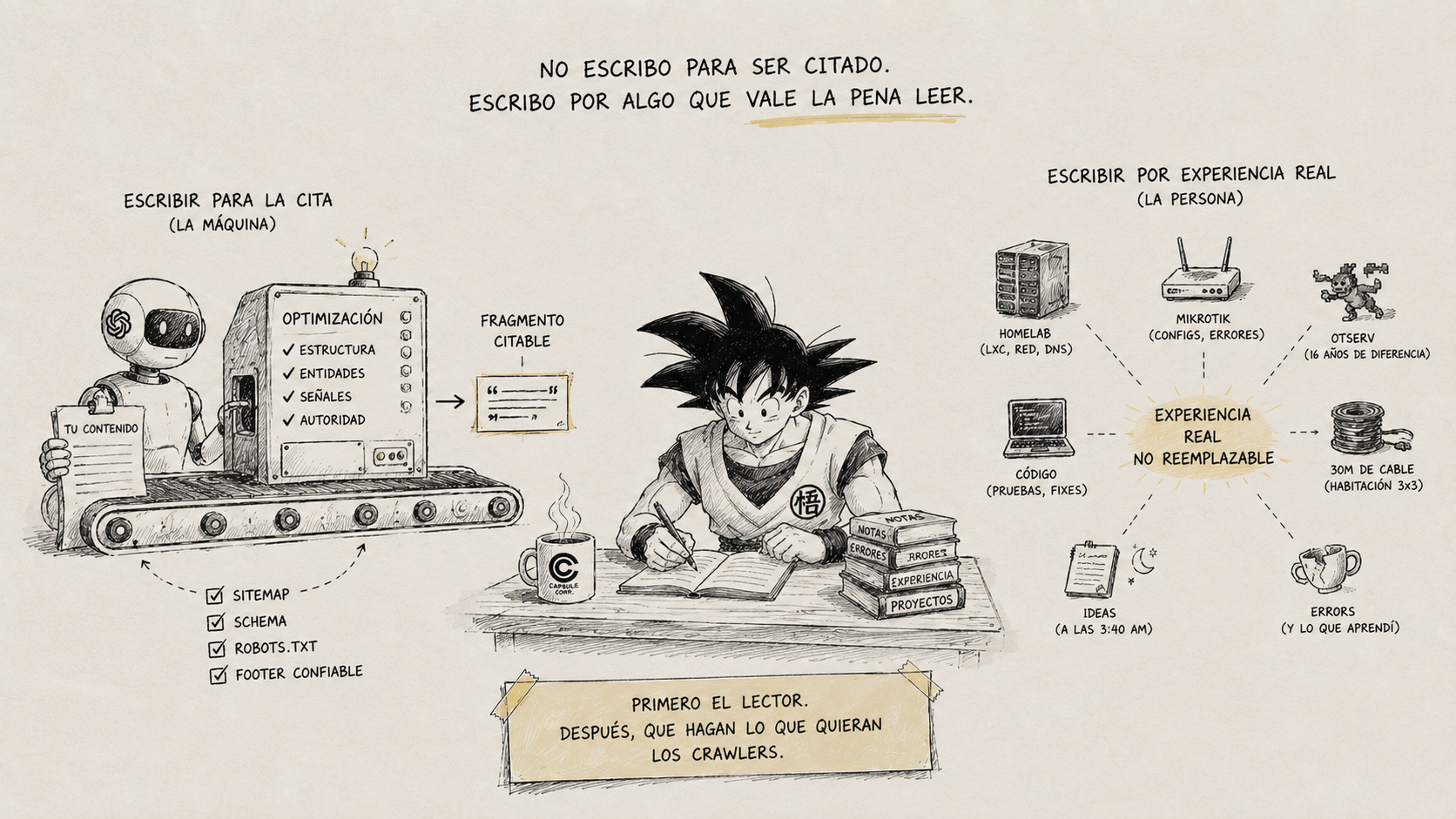
What bothered me was something else: the sense that the end goal was getting the citation, not reaching the reader. Optimizing the About page to look trustworthy instead of building something that actually is. Writing paragraphs while thinking about which fragment a model might lift, not about what someone who arrived looking for an answer needs to understand. Turning lived experience into another checkbox on a list.
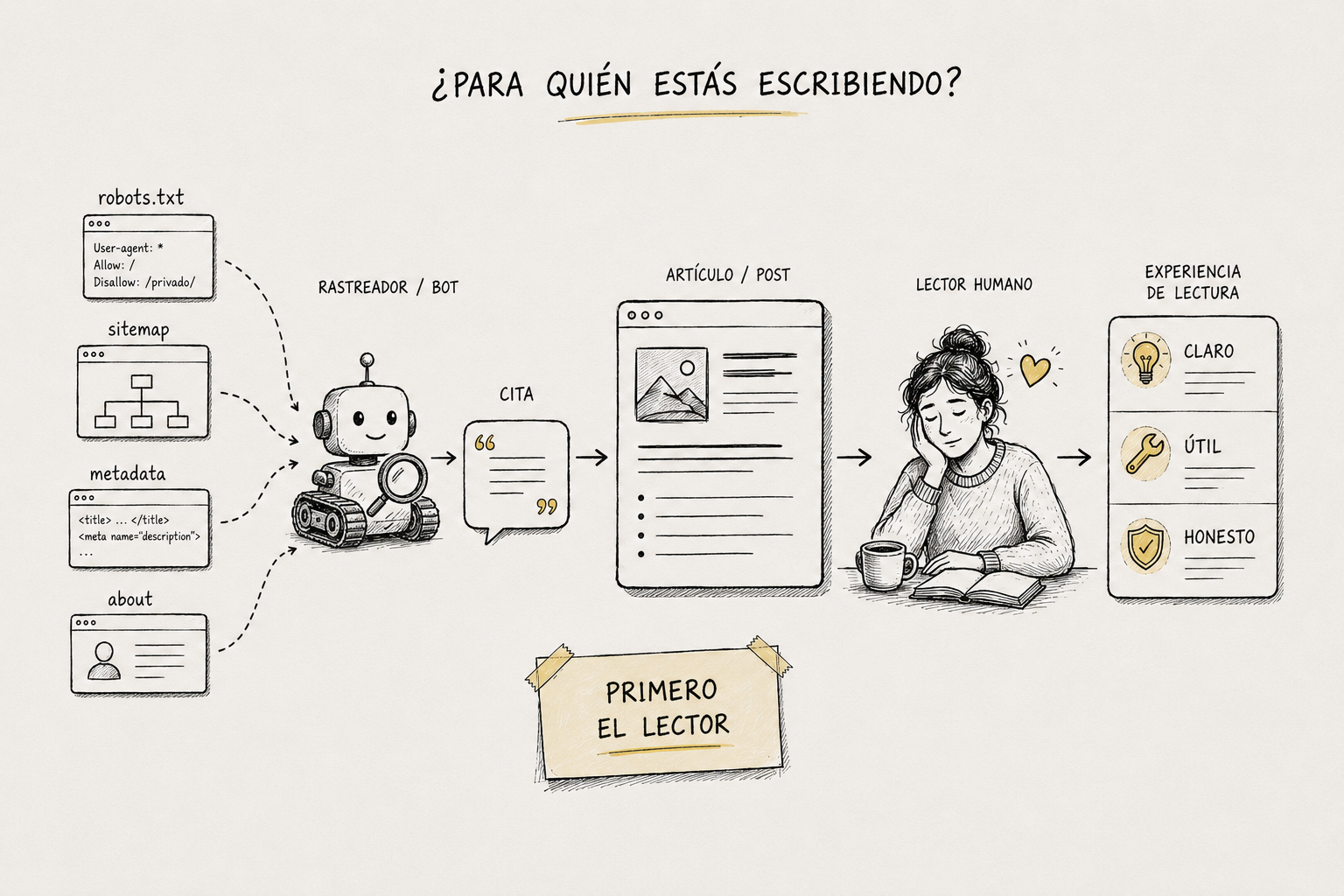
It is not exactly lying, but it gets pretty close to writing for the machine that will process the content instead of for the person who should read it.
A while ago, Fulanosaurio diagnosed me with brainrot using a Discord soundpad. The context barely matters. The diagnosis stuck as internal case law because, in some way, he was right: I had ended up producing content while thinking more about the stimulus than the message, and I do not have much appetite for making the same mistake under a different name.
The problem is not that an AI can read what I publish. It would be fairly absurd to put things on the internet and then get upset because something processes them, summarizes them, or uses them to build an answer. The problem starts when the chance of being cited begins to decide how we write, because then the reader stops being the reason for the article and becomes a fairly secondary consequence.
On the other side is Durmonski, who writes long articles, without much urgency, for people who still want to think with some calm. I do not know whether he applies GEO, whether he checks robots.txt every week, or whether he wonders which parts of his texts ChatGPT might lift. He probably does several technical things well, but that is not the first thing you notice when you land there. You notice that he writes about things he read, tried, or thought about long enough to have something of his own to say.
I write four- or five-minute articles because that is my real quota. Not because Google, ChatGPT, or some SEO tool decided that was the perfect length. I write until I feel the idea is complete, or at least ordered enough that it stops chasing me.
Different formats, but a fairly similar compass: the reader comes first. After that, we will see what the crawler does.
The article also mentioned the footer as one of the places to add trust signals. That made me look at this blog’s footer, which has links to my projects, the About page, and little else. No testimonials, no inflated numbers, no corporate line explaining how I am transforming the industry from a refurbished mini PC.
I could add all of that. Some automated audit would probably call it an improvement. It would also stop looking like me, which should be a far more important signal than any score.
An AI cannot cite what does not exist. It can summarize it, rearrange it, and probably explain it better than I can, but it cannot replace the experience of getting locked out of my own network several times by misconfiguring a MikroTik. It also cannot have spun up the homelab LXCs, broken DNS, migrated an OTServ with more than sixteen years of version differences, or pulled thirty meters of ethernet cable for a three-by-three room.
It can invent that. It cannot have lived it.
And that difference matters because GEO does not create substance. It can help something that already exists become easier to find, understand, or cite, but it cannot turn an empty text into a real experience. The problem appears when we confuse the way something is presented with the reason anyone should care enough to read it.
A page can be perfectly structured, with schema, author, references, update date, and every correct signal. It can also say absolutely nothing.
That is why this blog’s About page matters more to me than any meta description. Not because it is optimized in some special way, but because the real path is there. The projects that worked, the ones I abandoned, the ones I still keep going without fully understanding why, and the things I learned while trying to solve problems I had often created myself.
It is not a mission statement written to sound like a twenty-person company. It is a way of explaining why I write about these things.
The trap that really worries me is optimizing an article so hard into a citable source that it stops sounding like a person. Every paragraph with the right structure, the necessary entities, and a summarizable answer, and then nobody can tell who wrote it.
This blog already has scars from other excesses. The soundpad is a witness. I do not need to add a new version of the same mistake, this time wearing digital marketing vocabulary.
There is also something strange about first-hand experience showing up now as a positioning tactic. For me it is not a tactic. It is the only thing I have to offer.
I do not have a content team, an ads budget, or an editorial calendar planned three months ahead. I have projects, mistakes, a few ideas, a mini PC, a router that once locked me out of my own house, and whatever focus survives after work. Turning all of that into a strategy for getting citations feels a bit like writing a procedure for how to breathe.
That does not mean I do not care if ChatGPT cites this blog. It would be interesting if someone asked about homelabs, AppSec, identity, or some strange obsession and ended up here. It would also be fairly funny if they wanted a quick answer and ran into a guy talking about thirty meters of ethernet cable.
If they stay, it is probably because they found an idea, a story, or a mistake they could recognize themselves in, not because the footer had the correct number of trust signals. And if they do not stay, that is fine too. At least I published something I can sign with my name without feeling embarrassed when I read it again in a few months.
I am going to check this site’s robots.txt. I am also going to make sure the sitemap works, that pages can be indexed, and that bots can reach the content I chose to make public. That is technical hygiene, like washing your hands before cooking. It matters, but it is not the recipe.
The recipe, assuming there is one, is still fairly simple: do not publish anything I would not say out loud in front of someone who knows me well enough to notice when I am telling something that really happened and when I am trying to sound more interesting than I am.
If an AI decides to cite it afterward, great, but the goal cannot be the citation. First there has to be something worth reading.