/ blog
When identity becomes infrastructure: IDAnimal
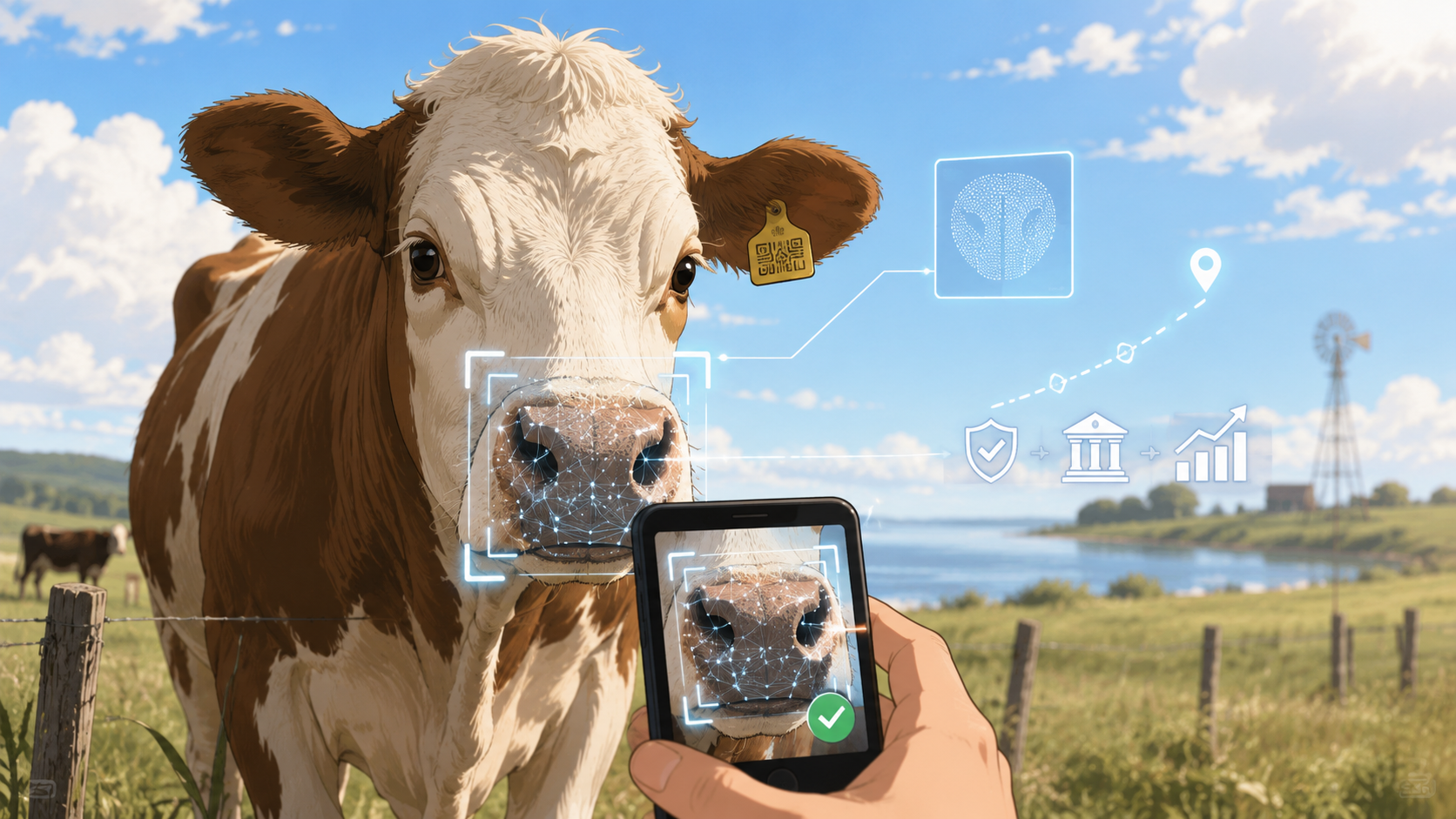
I ran into IDAnimal looking for something completely different, the way it almost always goes with ideas that end up as a post. The pitch sounds like rural science fiction: use the print of a cow’s muzzle a “nasobiogram”, to give each animal what they present as an inviolable digital ID, and with that turn livestock that can still be an opaque asset into real collateral for a bank or an insurer.
They already have a livestock credit product running with SANCOR Seguros and Banco del Sol. It is not a mockup. It is a product working alongside real institutions.
Uruguay is an agro country down to the coat of arms. I am not saying that from the outside. I was born in a rural area. On the prairie I learned the hard way, like almost everyone: irrigation, animals, butchering, cutting forage strips, machinery. I will not pretend I am a producer or a banker, or that I understand the cattle business end to end. But I will not write as someone who discovered cows in a paper either.
I know the mud. I know what an animal weighs when it stops being an idea and becomes work, smell, money, risk.
IDAnimal is Argentine the headquarters, the blog and the alliance with SANCOR and Banco del Sol make that clear, not a Uruguayan solution. I am reading it from here, across the river. I do not know whether something equivalent exists in Uruguay: if it does, it never hit me with the same force. And that gap, or that invisibility, is part of why I kept looking.
The problem it attacks serious animal identification, traceability that can survive export, livestock that can serve as collateral is not exclusive to Argentina. It is regional. Uruguay exports beef, lives on traceability, and has mandatory individual identification for cattle. The ear tag does not only identify a lot: it identifies each animal inside the system, tying it to a number and a history.
But it is still an external object hanging from an ear.
It can be lost, broken, swapped, or incorrectly associated. So the tension is not that Uruguay lacks individual traceability, because it does not, but how to prove that the animal in front of you is physically the same one that started the chain and that owns that record.
From this side, the question is not only “does their business work?”. It is also “what if something like this existed here?”. Not as a fan, and not as a pitch. As someone who knows the Uruguayan countryside enough to imagine the impact, and digital identity enough to look at it with judgment.
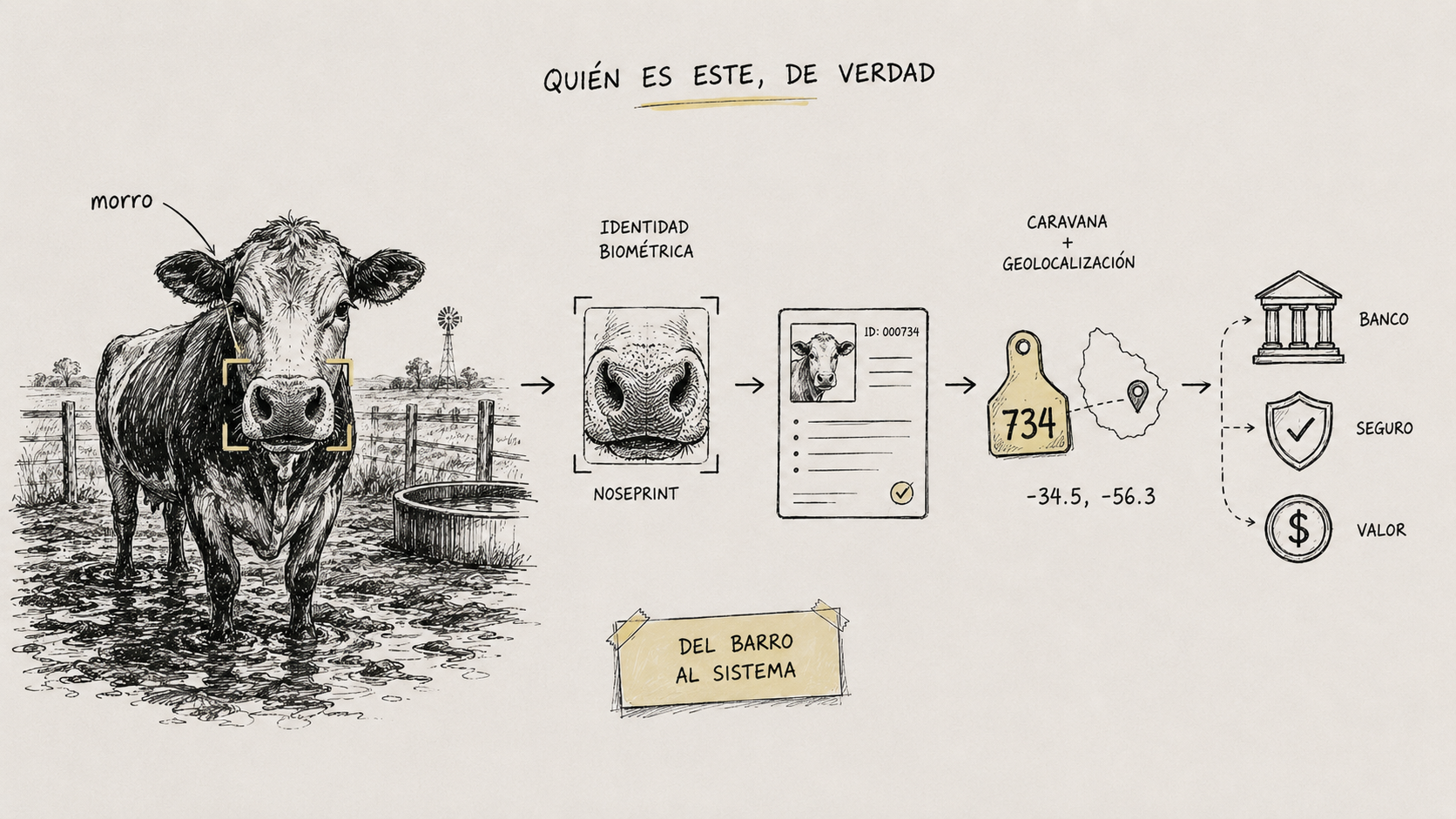
That question has a bovine version. The plastic ear tag is the old ID: useful, mandatory, integrated into the system, but external to the animal. The muzzle, instead, is like a fingerprint: each one has its own, distinct, hard to spoof. A phone app takes four to eight photos, a model trained with convolutional neural networks identifies the pattern, and that pattern becomes a unique identifier that can later be crossed with the ear tag, geolocation, breed, and establishment.
Biometric identity tied to a financial asset. The whole architecture of “who is this, really” that shows up in software, transplanted into the mud.
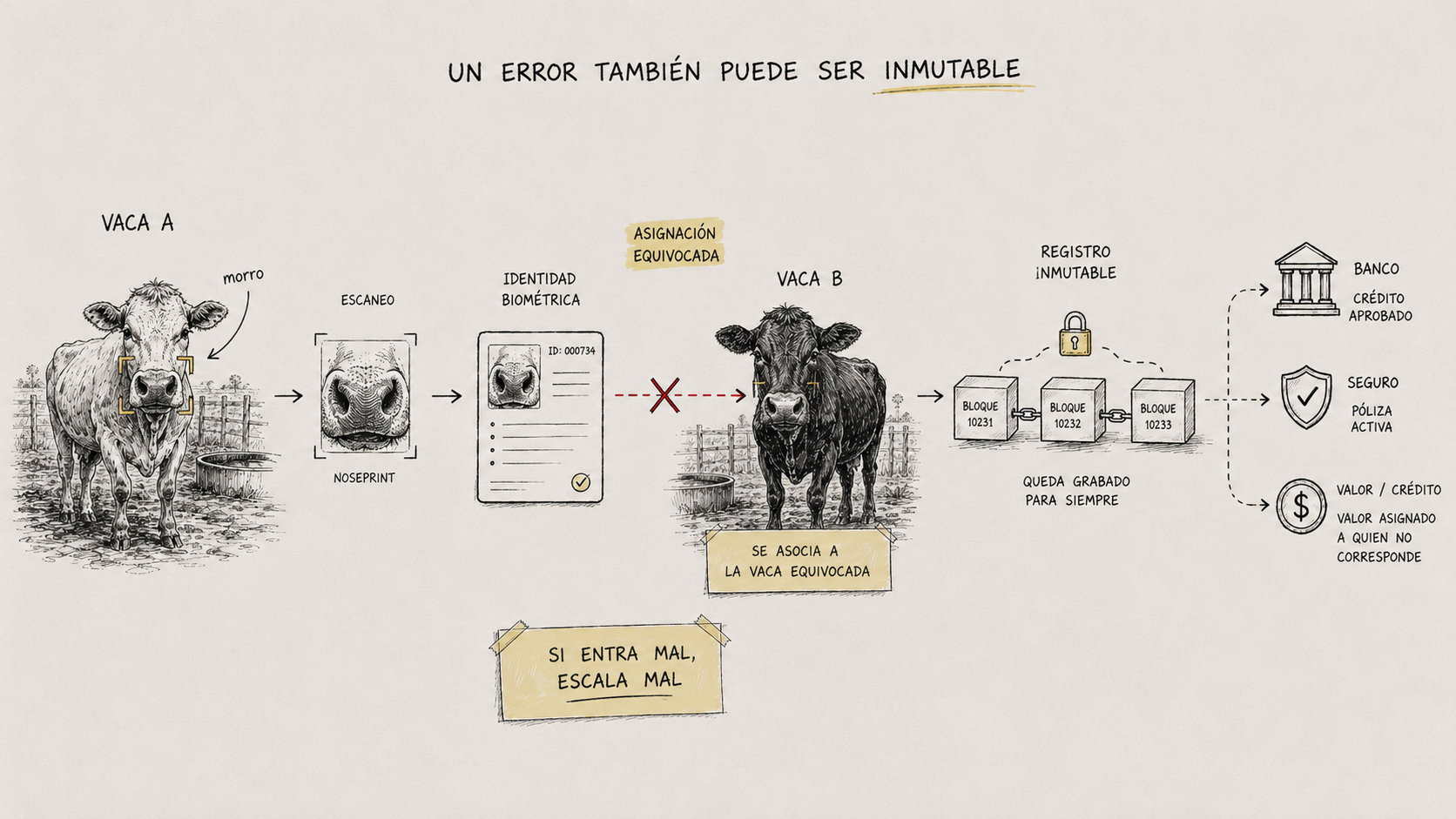
IDAnimal also talks about blockchain, though publicly it does not explain much about which network it uses, what information it records there, or what still lives in its own database. And maybe that is the least interesting part of the word itself. Blockchain can help prove that a record was not changed after a certain point, but it does not guarantee that what entered the system was correct.
An error can also be immutable.
What I celebrate about this, without sarcasm, is that someone is trying to add a layer that complements the ear tag, the existing records, and the trust among everyone in the chain. Framing the problem as ecosystem producer, bank, insurer, slaughterhouse, State instead of as an isolated app that solves a small use case, is exactly the kind of ambition you almost never see in software outside a large corporation.
Because it is not enough for a camera to recognize a cow’s muzzle. The producer has to register the animal, the bank has to trust that identity as collateral, the insurer has to verify that what it is covering is still the same thing, and the rest of the chain has to accept that the record arrived there without turning into something else.
If nothing similar is visible in Uruguay, that is not an argument against them. It is an invitation to look more carefully at which local rural problems could still be solved better by connecting identity, technology, and access to the financial system.
Now, the part where I look with real caution, not fan energy. A recognition model trained on muzzle photos has false positives and false negatives, like any model, and here an error is not just a locked account: it is a loan issued against the wrong animal, duplicated collateral, or one animal identified as another.
The environment changes too. Lighting, mud, a lesion, the animal moving, the camera used, or simply a photo taken with little care. Variables that can look small in a demo, but that in the middle of a rural establishment become part of the system.
And then comes the least attractive question, the one that never gets the same space in a presentation: where does that identity actually live?
I do not know whether they store the original photos, a biometric representation, an embedding, a hash, or some combination of all of it. I also do not know what ends up on blockchain and what depends on IDAnimal’s own infrastructure. But even if the muzzle is unique, its digital representation is still a record. Someone creates it, someone stores it, and someone decides who can query it, correct it, or link it to a financial operation.
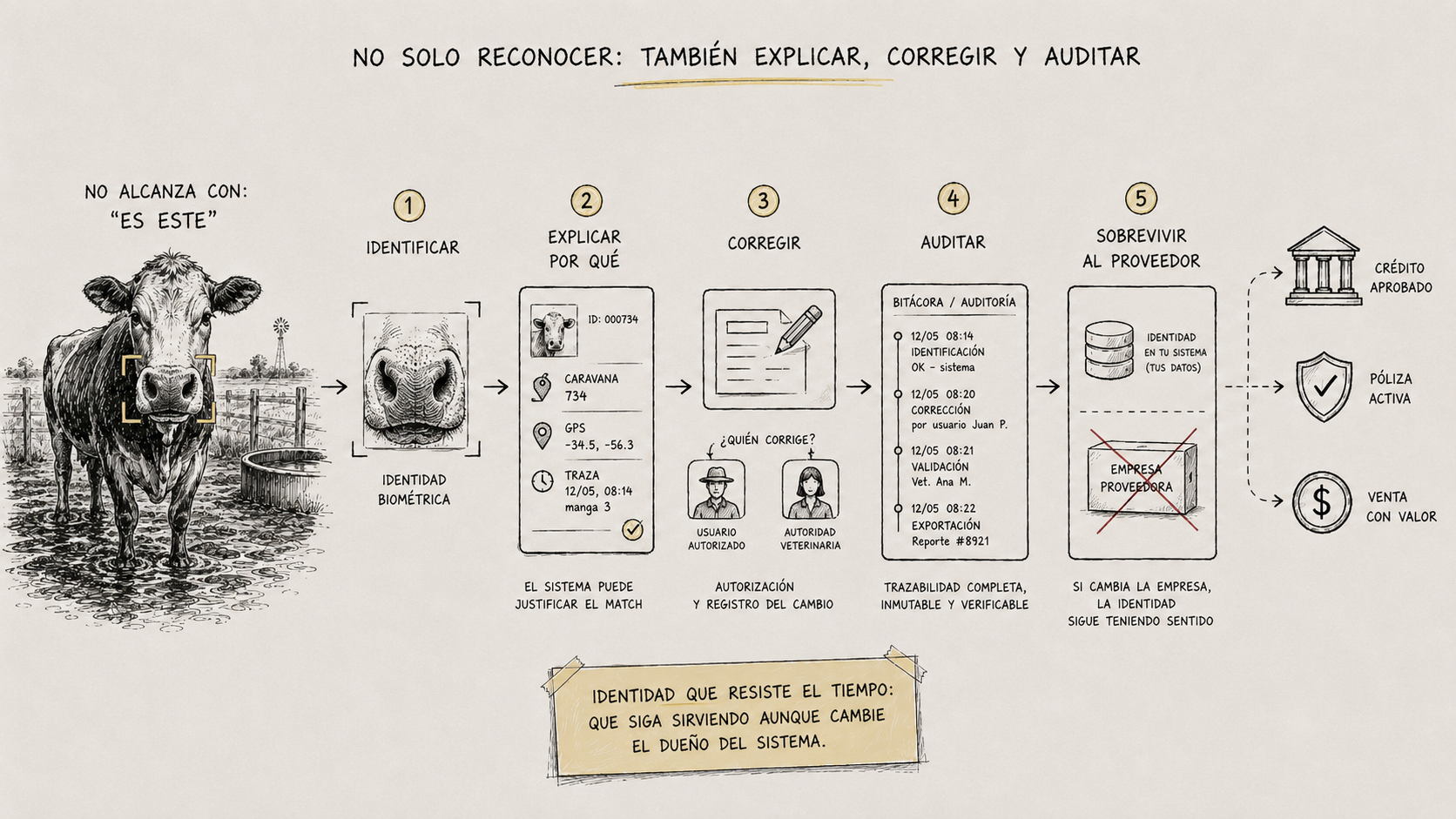
What happens if the provider shuts down, changes owners, or changes how it administers that data? Can the producer keep using their animals’ identity with another institution? How do you correct a record without breaking everything that already depends on it?
The existence of a product working with a bank and an insurer shows that the application is real. It does not mean every possible question has a public answer, but that does not take away from the achievement either. These are the problems that appear when a good idea stops being a demo and starts becoming infrastructure.
I would ask the same questions if a Uruguayan version showed up tomorrow, or if someone brought this to the local market. Not because I would be looking for an excuse to tear it down, but because I would want to see it work.
The border does not change the rigor.
There is something almost funny about how direct the metaphor is: I identify users, tokens, sessions. They identify cows. But the rigor I demand from a bank login system what happens if the token leaks, how long it lasts, who can revoke it is exactly the rigor I should apply to any system that decides, with an algorithm, that an animal is who it claims to be.
If a bovine identity is registered incorrectly, I also need to understand who can correct it, who authorizes the change, and what happens to the loans, policies, or movements already tied to it.
The risk rhymes even if the subject has four legs and does not know it is participating in anything.
I did not come to review IDAnimal’s stack as if I were a client scoring a vendor, and I did not come to talk down the achievement of having something working with real banks. In fact, I probably kept looking at the product for so long because it takes an extremely physical problem and connects it with digital identity, artificial intelligence, and access to financing in a way that makes sense.
I came to steal the deeper question, the one that helps me from Uruguay and beyond the countryside: how many assets stay opaque because we never built a trustworthy enough identity around them, and how many problems we keep solving with plastic, paperwork, and trust because nobody managed to connect the producer, the financial system, and the technology in a sensible way.
When an identity stops serving only to recognize something and starts backing a loan, enabling a sale, or justifying a policy, it is no longer enough for the system to answer “this is the one”. It also has to sustain that answer over time, allow correction when it is wrong, and still make sense even if tomorrow the company that built it changes.
That applies to a bank account, to a person, and apparently also to a cow. The subject changes. The responsibility, not so much.
Maybe that is why I kept looking at IDAnimal from this side of the river. Not because I think it is a definitive solution, and not because I have all the information needed to evaluate it, but because it is one of those ideas that make you look at a familiar problem from a completely different place.
And because, honestly, I would like to see something like this in Uruguay.